
On February 24, 2025, Cloudflare experienced a catastrophic global outage that paralyzed significant portions of the internet for nearly six hours. The incident, triggered by a faulty configuration file in their bot management system, affected millions of websites and services worldwide. This analysis examines the chronology, technical causes, widespread impact, and important lessons from what has become one of the most significant internet infrastructure failures of the decade.
Timeline of the Cloudflare Outage
The Cloudflare outage began at 07:42 AM UTC on February 24, 2025, when the company’s monitoring systems detected an unusual spike in error rates across their global network. Within minutes, websites and services relying on Cloudflare’s infrastructure began experiencing widespread disruptions as traffic management systems failed across multiple regions.
Detection and Initial Response
At 07:42 AM UTC, Cloudflare’s automated monitoring systems flagged an abnormal increase in error rates across their network. By 08:15 AM UTC, the company had published their first acknowledgment on the Cloudflare status page, confirming they were investigating “widespread issues affecting multiple services.” Internal incident response teams were immediately mobilized, with engineers focusing on identifying the source of the rapidly escalating failures.
Mitigation and Service Restoration
By 10:30 AM UTC, Cloudflare engineers had identified the root cause and implemented initial mitigation measures, resulting in partial service restoration for approximately 40% of affected traffic. Full service recovery was achieved at 13:28 PM UTC, nearly six hours after the initial detection, when the company deployed a comprehensive fix and rolled back the problematic configuration changes across all data centers globally.
During the incident, Cloudflare temporarily disabled their bot management system worldwide as part of their emergency response protocol. This unprecedented measure reflected the severity of the situation but also created secondary vulnerabilities for websites normally protected by these services.
Root Cause Analysis
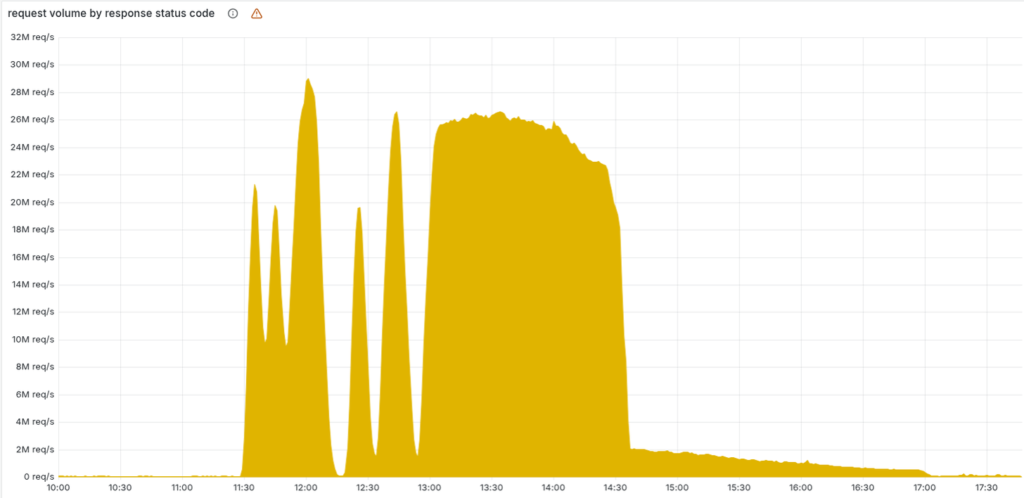
According to Cloudflare’s post-incident analysis, the outage stemmed from a critical error in their bot management system. A routine configuration update deployed at 07:35 AM UTC contained an improperly formatted rule set that exceeded size limitations for the traffic processing engine. This oversized configuration file triggered a fatal exception in the bot management system, which then cascaded throughout Cloudflare’s interconnected services.
“What we experienced was a perfect storm of failures. A seemingly minor configuration change to our bot management system contained an error that exceeded processing parameters. When this file was deployed globally as part of our routine updates, it triggered a cascading failure across our traffic management infrastructure.”
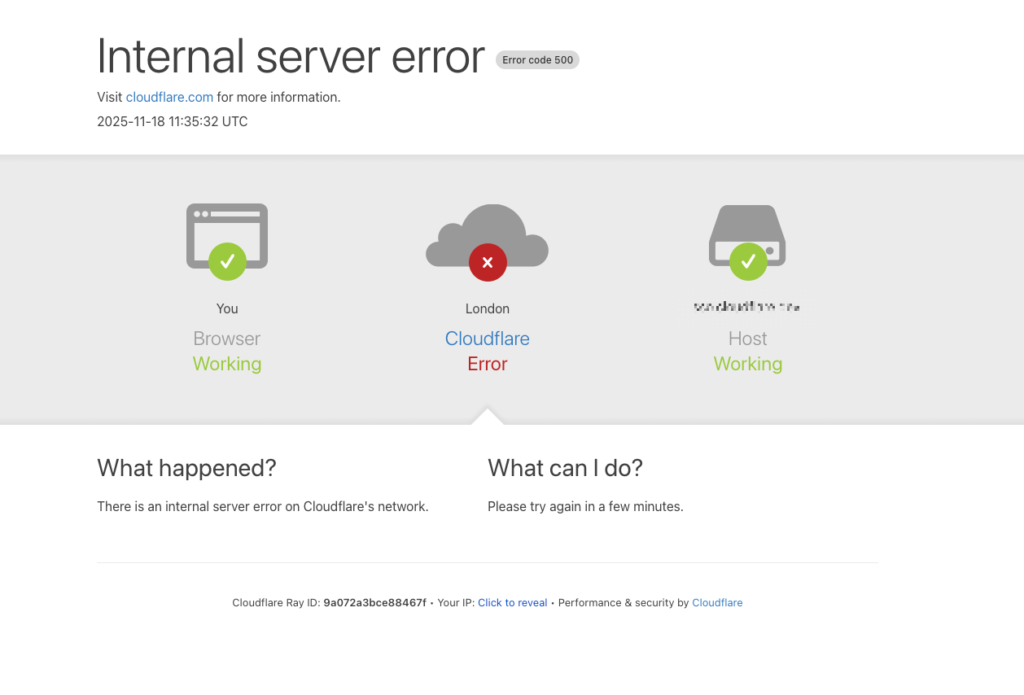
The company confirmed that the incident was not the result of a cyberattack or external breach. Rather, it originated from an internal deployment process that lacked sufficient validation checks for configuration file integrity and size limitations before global distribution across their network.
Technical Breakdown of the Failure Mechanism
The failure sequence began when Cloudflare’s automated systems deployed an updated configuration file containing new bot detection rules. This file had grown to approximately 4.8MB—nearly three times larger than the 1.7MB limit supported by the traffic processing engine. When the oversized file was loaded into memory, it triggered buffer overflow conditions in the bot management system, causing worker processes to crash and restart in an endless loop.
Affected Services and Geographic Impact
| Service Category | Major Affected Platforms | Nature of Disruption | Geographic Severity |
| Financial Services | Chase Bank, PayPal, Stripe, Wise | Payment processing failures, authentication errors | Global, severe in North America |
| E-commerce | Amazon, Shopify stores, Etsy, eBay | Checkout failures, inventory management issues | Global, particularly severe in Europe |
| Social Media | Instagram, Discord, Reddit, LinkedIn | Content loading failures, authentication issues | Global, uniform impact |
| Streaming Services | Netflix, Disney+, Spotify, Twitch | Stream initialization failures, content delivery errors | Most severe in North America and Europe |
| Productivity Tools | Notion, Slack, Asana, Monday.com | Synchronization failures, access issues | Global business impact |
| News & Media | CNN, BBC, New York Times, Reuters | Content delivery failures, increased latency | Global, varied by region |
The outage affected approximately 32% of all websites using Cloudflare services, with particularly severe impacts on sites heavily dependent on the company’s bot management and DDoS protection features. Geographic impact analysis showed that while the disruption was global, regions with higher concentrations of Cloudflare edge servers—particularly North America and Western Europe—experienced more severe and prolonged service degradation.
Cloudflare’s Official Response
Throughout the incident, Cloudflare maintained communication through multiple channels, though their response strategy evolved significantly as the severity of the outage became apparent.
Initial Communication Challenges
Cloudflare’s first public acknowledgment came at 08:15 AM UTC via their status page, approximately 33 minutes after initial detection. This delay in communication became a point of criticism, as many businesses were left without information during the crucial early stages of the outage. The initial status update was notably vague, describing only “degraded performance across multiple services” without specifying the scale or potential duration of the disruption.
Transparency Improvements
By 09:20 AM UTC, Cloudflare had significantly improved their communication approach, establishing an incident-specific status page with real-time updates. The company began providing technical details about the nature of the problem and regular progress reports on mitigation efforts. They also activated their emergency communication protocols, with updates being pushed through multiple channels including Twitter, their blog, and direct emails to enterprise customers.
“We recognize that our initial communication fell short of what our customers expect and deserve. As we worked to understand the scope of the issue, we should have been more forthcoming about what we knew and didn’t know. We’re reviewing our incident communication protocols to ensure faster and more transparent updates during future incidents.”
Post-Resolution Accountability
Following service restoration, Cloudflare published a preliminary incident report within 24 hours, followed by a comprehensive technical post-mortem five days later. The company took full responsibility for the outage, detailing not only the technical failures but also the process breakdowns that allowed the problematic configuration file to be deployed without adequate testing. They announced immediate changes to their deployment validation procedures and committed to a six-month infrastructure resilience improvement program.
Business and Economic Impact
The economic consequences of the February 2025 Cloudflare outage were substantial and far-reaching. Preliminary analyses from financial research firms estimated the total global economic impact at approximately $1.4 billion in lost transactions, productivity disruptions, and recovery costs across all affected sectors.
E-commerce and Retail Losses
The e-commerce sector bore the heaviest financial burden, with estimated losses exceeding $420 million globally. Major platforms like Shopify reported that their merchants experienced an average 82% drop in transaction volume during the outage. For many smaller online retailers operating on thin margins, the six-hour disruption represented a significant percentage of their monthly revenue. The timing of the outage—during peak business hours across North America and Europe—maximized its financial impact.
Operational Disruptions
Beyond direct revenue losses, the outage created substantial operational challenges for businesses reliant on cloud-based tools and services. Companies using Cloudflare-protected productivity and communication platforms reported significant workflow disruptions. A survey conducted in the aftermath found that 64% of affected businesses had no contingency plans for this type of infrastructure failure, highlighting a critical gap in business continuity planning for cloud-dependent operations.
Stock Market Reactions
Cloudflare’s stock (NYSE: NET) dropped 17.8% in the immediate aftermath of the outage, erasing approximately $5.2 billion in market capitalization. The sharp decline reflected investor concerns about potential customer churn and long-term reputational damage. Interestingly, competitors like Fastly and Akamai saw temporary stock gains of 4.2% and 3.7% respectively, as the market anticipated potential customer migrations away from Cloudflare.
Technical Deep Dive
Cloudflare’s infrastructure consists of a globally distributed network of over 350 data centers that collectively process approximately 45 trillion requests daily. This massive scale requires highly automated systems for configuration management and deployment—the very systems that failed during the February 2025 incident.
The Configuration File Architecture
At the center of the outage was Cloudflare’s bot management system, which relies on regularly updated configuration files containing rules and patterns for identifying and mitigating malicious traffic. These files are generated through a combination of automated systems and human input, then distributed globally to all edge locations. The specific file that triggered the outage contained definitions for detecting and blocking increasingly sophisticated bot networks that had been targeting e-commerce platforms.
Technical Detail: The problematic configuration file contained approximately 18,500 rule patterns, exceeding the system’s designed capacity of 12,000 patterns. Additionally, several complex regular expressions within the file created exponential processing requirements that overwhelmed the traffic processing engine when attempting to apply these patterns to incoming requests.
Failure Propagation Mechanics
When the oversized configuration file was deployed, it triggered a cascading failure that spread through Cloudflare’s infrastructure in three distinct phases. First, the bot management workers began crashing when attempting to load the oversized rule set. Second, as these workers repeatedly crashed and restarted, they created CPU and memory contention issues on the physical servers. Finally, the traffic management layer, unable to properly route requests through the failing bot management system, began generating its own errors, effectively amplifying the original failure across the entire network.
Comparison to Previous Major Outages
The February 2025 Cloudflare incident joins a series of significant internet infrastructure failures that have occurred in recent years. Comparing these events provides valuable context for understanding the evolving nature of systemic risks in our increasingly interconnected digital ecosystem.
| Incident | Date | Duration | Root Cause | Estimated Impact |
| Cloudflare Outage | February 2025 | 5 hours 46 minutes | Oversized configuration file in bot management system | 32% of Cloudflare-served websites; $1.4B economic impact |
| CrowdStrike Incident | July 2024 | 18 hours | Faulty security update to Windows systems | 8.5M computers; $3.2B economic impact |
| Microsoft Azure Outage | January 2023 | 7 hours 20 minutes | DNS configuration error | Multiple Microsoft services; $1.2B economic impact |
| Facebook Global Outage | October 2021 | 6 hours | BGP configuration change | All Facebook services globally; $0.9B economic impact |
While the Cloudflare outage was shorter in duration than some comparable incidents like the CrowdStrike event of July 2024, its impact was particularly severe due to the critical nature of Cloudflare’s services in the internet ecosystem. Unlike more contained incidents affecting single platforms, the Cloudflare disruption had a multiplicative effect across thousands of dependent services and websites.
Lessons Learned and Preventive Measures
The February 2025 Cloudflare incident offers valuable lessons for both infrastructure providers and the businesses that rely on them. These insights can help improve system resilience and minimize the impact of future outages.
For Cloud Infrastructure Providers
- Implement strict validation checks for configuration files before deployment, including size limits and syntax verification
- Develop progressive rollout protocols that deploy changes to limited regions before global implementation
- Design circuit-breaker mechanisms that can automatically revert to previous configurations when anomalies are detected
- Improve isolation between critical systems to prevent cascading failures
- Establish redundant communication channels for status updates when primary systems are compromised
For Businesses Using Cloud Services
- Develop comprehensive multi-cloud strategies to reduce dependency on single providers
- Implement local caching and fallback mechanisms for critical content and functionality
- Create and regularly test business continuity plans specifically for cloud infrastructure failures
- Establish clear communication templates and protocols for notifying customers during service disruptions
- Consider cyber insurance policies that specifically cover business interruption due to cloud provider outages
In response to the incident, Cloudflare announced several significant changes to their infrastructure and processes. These include implementing a new multi-stage validation system for configuration files, enhancing their canary deployment process to catch issues before global rollout, and redesigning their bot management system to handle graceful degradation rather than catastrophic failure when encountering problematic configurations.
Industry Expert Reactions
“The Cloudflare incident highlights a fundamental challenge in modern internet architecture: the inherent tension between centralization for efficiency and decentralization for resilience. When a handful of companies provide critical infrastructure for vast portions of the internet, their internal technical failures become systemic risks for the global digital economy.”
Industry experts have noted that the February 2025 Cloudflare outage represents a watershed moment in how businesses think about cloud infrastructure dependency. The incident has sparked renewed discussions about concentration risk in internet architecture and the need for more resilient design patterns.
The Centralization Dilemma
Cybersecurity and infrastructure experts point to the increasing concentration of internet traffic through a small number of providers as both a strength and vulnerability. While centralization enables sophisticated security protections and performance optimizations at scale, it also creates potential single points of failure with far-reaching consequences. The Cloudflare incident has accelerated discussions about whether regulatory frameworks similar to those in financial services might be needed to address systemic risks in digital infrastructure.
“What’s particularly concerning about the Cloudflare incident is how a relatively simple configuration issue could cascade so dramatically. It reveals how the complex interdependencies in modern cloud systems can amplify small errors into major disruptions. This should be a wake-up call for organizations to rigorously test their resilience against infrastructure provider failures.”
Future Implications for Cloud Infrastructure
The February 2025 Cloudflare outage is likely to have lasting effects on how cloud infrastructure is designed, deployed, and regulated. Several important trends are already emerging in response to this and other recent high-profile outages.
Architectural Evolution
Cloud providers are increasingly adopting microservice architectures with stronger isolation boundaries between components. This approach limits the blast radius of individual failures and enables more granular fallback mechanisms. We’re also seeing greater adoption of chaos engineering practices, where providers deliberately introduce failures in controlled environments to identify and address potential cascading failure scenarios before they occur in production.
Multi-Cloud Acceleration
Businesses are rapidly accelerating their adoption of multi-cloud strategies in the wake of the Cloudflare incident. Rather than simply distributing workloads across providers, advanced approaches now include active-active configurations where critical services simultaneously run on multiple infrastructure providers with real-time traffic distribution. This approach provides genuine resilience against provider-specific outages but introduces significant complexity in application design and management.
Regulatory Consideration
Policymakers in several jurisdictions have begun exploring whether cloud infrastructure providers should be subject to reliability and resilience regulations similar to those governing critical utilities or financial institutions. Proposed frameworks include mandatory resilience testing, incident reporting requirements, and potentially even capital reserves for major providers. While controversial, these discussions reflect growing recognition of cloud infrastructure as essential to economic and social functioning.
As digital transformation continues across all sectors, the resilience of underlying cloud infrastructure becomes increasingly critical. The lessons from the Cloudflare outage of 2025 will likely influence technology architecture, business continuity planning, and potentially regulatory frameworks for years to come, ultimately creating a more robust digital ecosystem better prepared for inevitable future disruptions.
Conclusion
The Cloudflare outage of February 24, 2025, stands as a powerful reminder of both the remarkable resilience and surprising fragility of our modern digital infrastructure. What began as a seemingly routine configuration update cascaded into a six-hour global disruption affecting millions of websites and services, with economic impacts exceeding $1.4 billion.
This incident highlights several critical realities about our increasingly cloud-dependent world. First, the concentration of internet infrastructure among a relatively small number of providers creates systemic risks that extend far beyond any single company or service. Second, the complex interdependencies within modern cloud systems can amplify small errors into major disruptions with surprising speed. Finally, business continuity planning must evolve to specifically address the unique challenges of cloud infrastructure failures.As we move forward, the lessons from this and other recent outages will hopefully drive improvements in system design, redundancy planning, and incident response—ultimately creating a more resilient digital ecosystem. For businesses and organizations of all sizes, the message is clear: in an interconnected world, preparation and diversification are not luxuries but necessities for operational continuity in the face of inevitable infrastructure challenges.

Comments are closed.